Digital growth roadmap for mid-sized businesses
By Michael Bridges · Published July 20, 2026
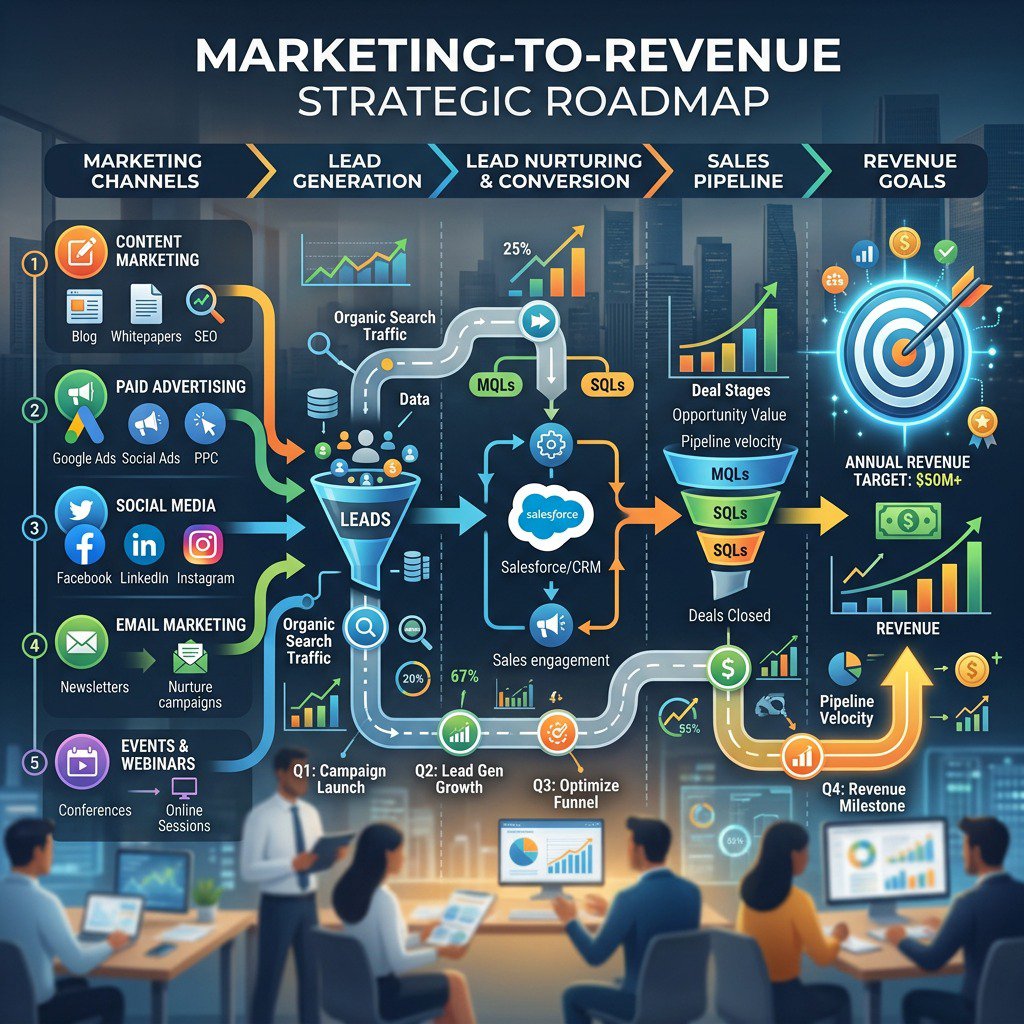
A digital growth roadmap helps mid-sized businesses move from scattered marketing activity to a practical plan tied to qualified leads, sales pipeline, and revenue. Instead of managing website updates, content, paid campaigns, email, and social media as separate projects, leadership teams can use one roadmap to set priorities, coordinate channels, and measure business impact. For companies also pursuing broader change, the roadmap can serve as a practical digital transformation strategy roadmap that connects marketing, operations, technology, and customer experience.
A digital growth roadmap for mid-sized businesses should clarify four questions:
- Which customer segments deserve the most attention?
- Which marketing channels should receive investment?
- Which metrics indicate real business progress?
- Which initiatives should be started, expanded, changed, or stopped?
This approach is useful when a company has outgrown referrals or disconnected campaigns but does not want to build and manage a large internal marketing department. It can also help business leaders connect day-to-day marketing decisions with broader business goals and business objectives.
The U.S. Small Business Administration recommends connecting marketing plans to target markets, competitive positioning, sales goals, marketing actions, budgets, and return on investment. Its marketing and sales planning guidance supports the same business-first approach.
Build a digital growth roadmap around business outcomes
A digital growth roadmap should begin with the company’s business objectives, not with a list of marketing channels. Those objectives should become the key components of the planning process, giving the team clear goals and a consistent way to evaluate each initiative.
For example, your leadership team may want to:
- Enter a new market
- Increase qualified opportunities
- Improve customer retention
- Build awareness in a specific industry
- Reduce dependence on referrals
- Support a new product or service
- Shorten the sales cycle
- Increase revenue from existing accounts
Each objective requires a different digital approach.
A company focused on market expansion may need stronger industry content, search visibility, and sales materials. A company focused on pipeline growth may need better landing pages, paid media, and lead follow-up. A company focused on retention may need customer education, email communication, and account-based content that supports customer experience transformation.
Write the primary business objective in one sentence. Then define how marketing will contribute to it.
For example:
Generate more qualified opportunities from manufacturing companies by improving industry-specific content, search visibility, and lead follow-up.
This statement is more useful than a general goal such as “increase digital engagement.” It gives your team a direction and creates a foundation for measurable decisions.
Your plan should also include a timeframe. A useful objective might be:
Generate 25 additional qualified opportunities from manufacturing companies during the next 12 months by improving search visibility, publishing two industry resources each month, and creating a dedicated follow-up process.
The objective should be specific enough to guide decisions but flexible enough to be updated when new information becomes available. It should also support measurable results rather than activity for its own sake.
Define your priority customer segments
Many mid-sized companies try to market to everyone who could potentially buy from them. This approach often produces broad messaging that does not clearly address the needs of any specific audience.
A stronger digital growth roadmap starts with a small number of priority segments and considers their specific needs, buying behavior, and expectations throughout the customer journey.
Your customer segments may be based on:
- Industry
- Company size
- Geographic market
- Buying need
- Revenue potential
- Sales cycle
- Existing customer value
- Use case
- Level of urgency
Market research and competitive analysis can help your team identify the customers you want to reach and the advantages your company can communicate. The U.S. Small Business Administration’s business planning guidance recommends using market research to understand customers and competitive analysis to identify ways to differentiate the business.
For each priority segment, document the following:
| Area | Key question |
|---|---|
| Business profile | What type of company are we trying to reach? |
| Primary need | What problem is the buyer trying to solve? |
| Business impact | What happens if the problem continues? |
| Buying roles | Who influences or approves the purchase? |
| Decision criteria | What does the buyer need to see before moving forward? |
| Objections | What may prevent the buyer from taking action? |
| Preferred channels | Where does the audience research solutions? |
- Operations leaders at companies with 50 to 250 employees
- Marketing directors preparing for a new market launch
- Business owners who rely heavily on referrals
- Existing customers who may need additional services
Each group may require different messaging, content, offers, and follow-up. Understanding these differences helps teams create a more people-first digital transformation roadmap that reflects how customers and employees actually interact with the business.
Create one clear market narrative
Once your target segments are defined, connect your digital activity through a shared market narrative.
Your narrative should explain:
- Who you serve
- What problem you help solve
- How your approach works
- What makes your company a credible choice
- What action the prospect should take next
This message should appear throughout your digital presence. Your website, content, advertising, email campaigns, and sales materials do not need to use identical wording, but they should reinforce the same positioning.
For example, a commercial technology company may center its message on helping growing manufacturers reduce operational delays through better systems integration. Its website can explain the service, its content can address common process challenges, paid advertising can promote a relevant assessment, and email can nurture prospects who are not ready to buy.
When each channel tells a different story, prospects may become confused. When the channels support one narrative, each interaction builds on the last one and contributes to a stronger customer experience.
A useful narrative also helps internal teams make faster decisions. Before launching a new campaign, ask:
- Does this campaign support one of our priority segments?
- Does it reinforce our primary market position?
- Does it lead to a relevant offer?
- Can sales explain how it connects to current business priorities?
If the answer is no, the campaign may create activity without strengthening the company’s growth strategy.
Choose two or three core channels
A focused roadmap does not require your company to be active on every platform.
In most cases, it is better to select two or three core channels and manage them well. The right mix depends on your audience, sales cycle, budget, and internal capacity. It should also reflect the suitable technologies available to support your strategy without creating unnecessary complexity in the tech stack.
Website and search
Your website should serve as the central destination for your digital growth efforts. It should explain your offers, support your priority segments, answer common buying questions, and make the next step clear.
Your website design and development strategy should support both the customer experience and the company’s business objectives.
Important website and search opportunities may include:
- Service pages for high-value offers
- Industry pages for priority segments
- Location pages for regional markets
- Educational articles
- Case studies
- Comparison pages
- Frequently asked questions
- Conversion-focused landing pages
Search should not be treated as a collection of keywords. It should support the questions your best prospects ask before contacting your team.
For example, a prospect may search for:
- How to choose a marketing partner
- What a website redesign should include
- How to improve lead quality
- Whether to invest in SEO or paid advertising
- How to measure marketing-sourced pipeline
- What to prepare before launching a new service
The content that answers these questions should connect naturally to relevant services, proof points, and next steps.
Paid media
Paid advertising can help a company reach a specific audience, promote an offer, or create faster testing cycles. However, paid media works best when it is connected to a defined conversion path.
Before increasing ad spend, confirm that you have:
- A specific audience
- A clear offer
- A focused landing page
- A measurable conversion
- A follow-up process
- A way to evaluate lead quality
A campaign that generates clicks but does not create qualified conversations may need a better offer, audience, landing page, or sales process. More budget will not solve a weak path to conversion.
Paid media should also be evaluated against the stage of the buyer journey. Awareness campaigns may be measured through reach or engagement, while bottom-of-funnel campaigns should be measured through qualified actions and pipeline contribution.
Email and content
Content and email can help your company remain visible during longer buying cycles. They are especially valuable when prospects need education, internal approval, or multiple conversations before making a decision.
Useful content may include:
- Buyer guides
- Industry insights
- Project examples
- Common mistakes
- Implementation checklists
- Cost and planning considerations
- Expert interviews
- Product or service explainers
The purpose is not to publish as much as possible. The purpose is to help the right prospects make progress toward a buying decision.
Content should also support sales conversations. If prospects frequently ask the same questions, those questions may become articles, email topics, comparison guides, or sales enablement resources.
Connect every channel to a conversion path
Every channel in the digital growth roadmap should have a defined role in the customer journey. This process helps teams coordinate channels, improve workflows, and identify opportunities to increase efficiency.
For example:
| Digital activity | Primary role | Possible conversion |
|---|---|---|
| Search-optimized service page | Capture active demand | Consultation request |
| Educational article | Build awareness and trust | Guide download |
| Paid campaign | Reach a defined audience | Landing page form |
| Email sequence | Nurture interest | Sales conversation |
| Case study | Reduce buying uncertainty | Project review request |
| Webinar or event | Support evaluation | Registration or meeting |
- A prospect discovers an educational article through search.
- The article directs the prospect to a relevant service page.
- The service page offers a checklist or consultation.
- The prospect submits a form.
- The sales or marketing team follows up based on the prospect’s needs.
- The opportunity is tracked through the pipeline.
This process gives each piece of content a job. It also makes it easier to identify where prospects are dropping out and how digital activity can support operational transformation.
Define lead and pipeline metrics
Digital growth becomes easier to manage when the team agrees on a small set of meaningful metrics.
Avoid building a dashboard filled with numbers that no one uses. Start with the measures that connect activity to revenue, support decision-making, and account for limited funds or other resource constraints.
Business metrics
These metrics show whether digital efforts are supporting company performance:
- Marketing-sourced pipeline
- Marketing-influenced pipeline
- Revenue from digital leads
- Customer acquisition cost
- Customer lifetime value
- Sales cycle length
- Conversion rate from opportunity to customer
Funnel metrics
These metrics help identify where prospects are progressing or getting stuck:
- Website conversion rate
- Qualified leads
- Marketing-qualified leads
- Sales-qualified leads
- Discovery meetings
- Opportunities created
- Proposal or quote requests
- Opportunity conversion rate
- Lead response time
Channel metrics
These metrics help you evaluate individual activities:
- Organic traffic to priority pages
- Paid campaign conversion rate
- Cost per qualified lead
- Email engagement
- Landing page performance
- Content-assisted conversions
- Branded search growth
- Return on advertising spend
Use definitions that sales and marketing both understand. For example, a “qualified lead” should represent more than a form submission. It should meet agreed criteria related to fit, need, authority, timing, or potential value.
Google’s marketing measurement framework recommends starting with clear business objectives, selecting appropriate measurement tools, comparing results against expectations, and assigning an action to each result. Its measurement planning resource provides a useful framework for connecting objectives to channels and outcomes.
Analytics can also support broader business model transformation by showing which audiences, offers, and customer journeys create the greatest value.
Prioritize initiatives with a simple scoring model
Mid-sized companies often have more ideas than resources. A scoring model can help leadership teams decide which initiatives deserve attention first.
Score each initiative from one to five in four areas:
| Criteria | Question |
|---|---|
| Business impact | Could this meaningfully support revenue or retention? |
| Audience fit | Does it reach a high-value customer segment? |
| Confidence | Do we have evidence that the approach can work? |
| Effort | How much time, budget, and coordination will it require? |
- Rewriting a high-value service page
- Creating a landing page for an active campaign
- Fixing conversion tracking
- Developing a case study for a priority segment
- Improving lead routing and follow-up
- Consolidating duplicate campaigns
- Updating outdated sales and marketing content
This approach keeps the roadmap connected to business value instead of allowing the loudest request to become the next project.
It also gives leadership a clear explanation for why one initiative comes before another. A project may be strategically useful but still receive a lower priority if it has weak audience fit or requires significant effort.
When evaluating technology initiatives, teams should also consider data security risks, implementation effort, and whether the proposed tools will work with existing systems. New technologies such as edge computing, ai, and advanced analytics may be useful in the right context, but they should support defined business needs rather than become goals on their own.
Phase investments in practical stages
A digital growth roadmap for mid-sized businesses should show what happens now, next, and later. A broader transformation program may include cultural transformation, sustainability-focused strategies, and changes to how teams collaborate, but the roadmap should remain practical and connected to business priorities.
Stage one: Establish the foundation
The first stage should address basic clarity and measurement. Typical activities include:
- Confirming priority segments
- Reviewing the current website
- Defining the core market narrative
- Auditing analytics and conversion tracking
- Aligning lead definitions with sales
- Identifying high-value pages and offers
- Documenting the current customer journey
This stage may not produce dramatic visibility gains immediately, but it creates the structure needed for better decisions. It also helps identify the staff performance, technology, and process improvements required for effective execution.
Stage two: Improve conversion and consistency
Once the foundation is in place, focus on the points where prospects interact with your company.
This may include:
- Updating service pages
- Creating segment-specific landing pages
- Improving calls to action
- Building email follow-up sequences
- Creating content for common buyer questions
- Retargeting qualified website visitors
- Improving the handoff between marketing and sales
The goal is to make existing traffic and interest more valuable.
Stage three: Expand what works
After you have reliable tracking and evidence of performance, increase investment in the activities that produce the strongest business results.
Expansion may include:
- Adding campaigns for another priority segment
- Increasing paid media in a proven market
- Creating a larger content program
- Developing account-based marketing plays
- Building customer advocacy and referral programs
- Testing new offers or geographic markets
Growth should follow evidence. If a channel has not been measured clearly, expansion may increase activity without improving outcomes.
Create a dashboard leadership will use
A useful dashboard should help leaders make decisions, not simply report activity.
A monthly leadership dashboard might include:
- Revenue target and actual performance
- Marketing-sourced pipeline
- Marketing-influenced pipeline
- Qualified leads by source
- Opportunities created
- Conversion rates by funnel stage
- Cost per qualified lead
- Website performance for priority pages
- Campaign results
- Planned initiatives and current status
Keep the first version simple. A small dashboard that is reviewed consistently is more valuable than a large dashboard that no one trusts.
Every metric should answer one of three questions:
- Are we reaching the right audience?
- Are prospects taking the desired next step?
- Is digital activity contributing to pipeline and revenue?
If a number does not help answer one of these questions, it may not belong in the leadership view.
For businesses that rely on local visibility, Google also provides guidance on connecting Google Business Profile data with Analytics. This can help teams evaluate actions such as website clicks, calls, direction requests, and other local interactions. Google’s Business Profile and Analytics guidance explains how this connection can provide a broader view of the customer journey.
Review the roadmap on a regular schedule
A digital growth roadmap is not a document that should sit unchanged for a year. Market conditions, buyer behavior, sales priorities, and campaign results will change. Regular conversations between business leaders, marketing, sales, and operations can help the roadmap remain relevant.
Set a regular review cadence:
- Weekly for active campaign and lead issues
- Monthly for performance and pipeline review
- Quarterly for strategy, budget, and priority changes
- Annually for broader positioning and channel planning
During each review, ask:
- What produced meaningful progress?
- Which activities created noise without enough value?
- Where are prospects dropping out?
- What feedback is sales hearing from the market?
- Which assumptions need to be tested?
- What should we stop, continue, or begin?
This process keeps the roadmap practical and prevents the team from continuing work simply because it was included in the original plan.
A quarterly review should also compare the original assumptions with actual results. Perhaps one segment generated more qualified opportunities than expected. Perhaps a channel produced engagement but no meaningful conversations. Perhaps the sales team discovered that prospects need a different type of content before requesting a proposal.
The roadmap should change when the evidence changes. It should also account for emerging future trends without allowing trends to distract from current business priorities.
Use the right operating model
A focused roadmap still requires ownership. Assign a responsible person for each major initiative, define the expected outcome, and document the dependencies.
For example, a new campaign may require:
- A positioning decision from leadership
- Copy and creative development
- Website or landing page updates
- Analytics configuration
- Sales follow-up
- Budget approval
- A reporting schedule
When these responsibilities are not clear, projects slow down and campaigns launch without the support they need. Unclear ownership can create resistance to change and make transformation efforts harder to sustain.
Create a simple responsibility table for each major initiative:
| Responsibility | Assigned owner |
|---|---|
| Business objective | Executive sponsor |
| Audience and positioning | Marketing or leadership |
| Content and creative | Marketing or agency partner |
| Website and technical updates | Web or technology owner |
| Lead follow-up | Sales or business development |
| Measurement and reporting | Marketing operations or analyst |
Know when to bring in outside support
A company may benefit from outside marketing support when:
- Internal marketing responsibilities are spread across several employees
- Important website updates remain unfinished
- Campaigns are launched without clear measurement
- Sales and marketing disagree about lead quality
- The company needs specialized design, SEO, advertising, or content expertise
- Leadership wants consistent execution without hiring several full-time specialists
- A new market or service requires a coordinated launch
The right partner should not simply add more activity. The partner should help the company make better decisions, execute consistently, and understand what is contributing to business goals.
Some companies also evaluate related needs such as accounting services or outsourced finance when planning growth investments. Resources such as Know Plante Moran may appear in broader business planning conversations, but marketing decisions should still be tied to the company’s own priorities, budget, and operating model.
Before selecting a partner, ask:
- Can they explain how their work connects to our business objectives?
- Do they understand our customers and sales process?
- Can they support both strategy and execution?
- How will they communicate progress?
- What will they measure?
- Who will be responsible for the work?
- What happens after the initial project is complete?
These questions can help distinguish a long-term strategic partner from a provider focused only on delivering isolated marketing tasks.
Make digital growth more predictable
A digital growth roadmap for mid-sized businesses does not promise that every campaign will succeed. It creates a disciplined way to choose priorities, connect marketing activity to sales goals, and learn from performance. It gives the company a practical place to coordinate digital activity while addressing the challenges that often accompany growth.
The most effective roadmaps usually share a few characteristics:
- They begin with a defined business objective
- They focus on a limited number of customer segments
- They use two or three core channels
- They connect activity to a clear conversion path
- They measure qualified pipeline, not only traffic
- They phase investments according to evidence
- They give leadership a simple view of performance
- They are reviewed and adjusted regularly
The goal is not to do more digital marketing. The goal is to make digital activity more coordinated, measurable, and useful to the business. This approach supports effective digital transformation by connecting customer needs, marketing execution, technology, and operations.
If your company has outgrown disconnected campaigns, contact Digital Venture to discuss your current priorities, digital gaps, and next growth opportunity.
More News

Website News to Know: September 2026 (WordPress security, Google spam update, ADA lawsuits)
Website news for September 2026. A WordPress flaw was attacked within hours, Google started a spam update, and accessibility lawsuits kept climbing.
Read Article →
Federal Website Modernization in 2026: What the America by Design Overhaul Means for Agency Websites
Federal website modernization is now a White House priority. Here is what the America by Design order requires, what the law already said, and a 10-step checklist agencies and local governments can use now.
Read Article →
The ADA website deadline moved to 2027. Here is what did not change for Oklahoma cities and towns.
Oklahoma cities and towns got more time on the ADA Title II website deadline, but not a pass. Here’s what changed, what didn’t, and what local governments should do next.
Read Article →Let's Build Something Together
Veteran-owned, Tulsa-based, and trusted by 375+ clients. Tell us about your next project.
Get In Touch →