Designed for Tulsa: using 2026 web design trends to create locally grounded, high-performing small business websites
By Michael Bridges · Published July 27, 2026
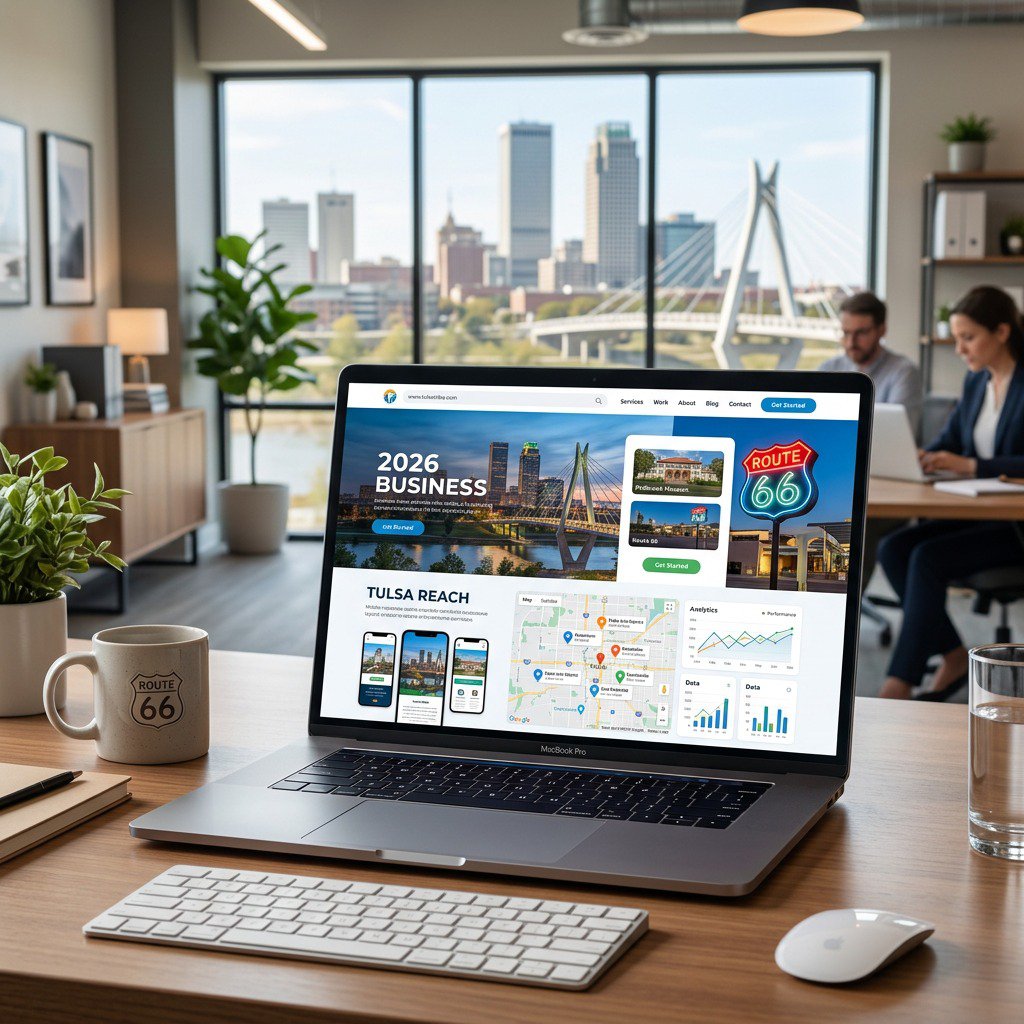
Tulsa web design should do more than look current. It should support internet marketing and digital marketing by helping local customers find your business, understand your services, trust your team, and take the next step.
That means combining modern visual design with the realities of doing business in Tulsa. Customers may search from Downtown Tulsa, Brookside, East Tulsa, South Tulsa, Bixby, Broken Arrow, Jenks, Owasso, or another part of the metro. They may search for a provider “near me,” compare businesses before a local event, or look for a company close to home or work.
A strong website connects those local needs with fast loading times, mobile usability, clear content, accessible design, and conversion-focused calls to action. In 2026, the best Tulsa web design is not simply attractive. It is useful, locally relevant, and built to support measurable business goals, business growth, and a stronger online presence.
Digital Venture’s Tulsa web design services combine website strategy, branding, development, local SEO, content, and ongoing support for businesses that need more than a disconnected website project.
What Tulsa web design needs to accomplish in 2026
The most valuable web design trends are not only visual. They improve how customers find, use, and trust a website while supporting smarter marketing decisions.
For a Tulsa-based business, the website should:
- Clearly explain what the business does
- Identify the primary service area
- Support searches such as “service near me” and “service in Tulsa”
- Work smoothly on mobile devices
- Load quickly on common mobile connections
- Use real imagery and locally relevant examples
- Make calls, bookings, purchases, and quote requests easy
- Answer common customer questions
- Give visitors a clear next step
- Reflect the company’s personality without becoming difficult to use
- Provide a foundation for search engine optimization, local SEO, and website marketing
Google primarily uses the mobile version of website content for indexing and ranking. Google also recommends responsive design and advises businesses to keep important content, headings, metadata, images, and structured data consistent across mobile and desktop versions. Read Google’s mobile-first indexing best practices before redesigning a website.
Digital Venture’s web design process begins with discovery and planning before moving into wireframing, development, refinement, launch, and ongoing support. That sequence helps connect design decisions to business priorities instead of treating visual design as the starting point.
Build a Tulsa web design visual identity without forcing it
Tulsa has strong visual references, including Art Deco architecture, Route 66, the Arkansas River, music venues, historic districts, and distinct neighborhood business areas.
Those references can inspire a brand system. However, they should support the company’s identity instead of becoming decoration.
A locally grounded website might use:
- Warm Oklahoma light in photography
- Architecture-inspired shapes or patterns
- Images of real Tulsa locations
- Neighborhood-specific project photos
- Local event photography
- A color palette that reflects the company’s market and personality
For example, a Tulsa home services company might use photographs of completed work in South Tulsa or Broken Arrow. A restaurant could highlight its proximity to a business district, entertainment venue, or residential neighborhood. A professional services firm might use a refined visual system inspired by Tulsa architecture without making every page feel historical.
The goal is not to make a website look like Tulsa. The goal is to make it look like your business in Tulsa.

Use color to support the brand
Color is one of the quickest ways to communicate tone.
A family-focused business may need a warm and welcoming palette. A law firm may benefit from a more restrained system. A creative company may use stronger contrast and expressive accent colors.
A practical color system usually includes:
- One primary brand color
- One or two supporting colors
- A high-contrast color for buttons
- Neutral backgrounds for readable content
- Consistent colors across the website, signage, social media, and print materials
Local inspiration can guide the palette. Brand strategy should make the final decision.
Choose real images over generic stock photography
Generic stock photography can make a local business feel interchangeable. Whenever possible, use images of:
- Your team
- Your location
- Your products
- Your equipment
- Your projects
- Your customers, with permission
- The neighborhoods and communities you serve
Local images also help visitors confirm that they are in the right place. An exterior photo, service vehicle, recognizable local setting, or Tulsa-area project can build trust before a customer calls.
For Tulsa web design, imagery should do more than fill space. It should show proof, establish location, and help customers imagine working with your business. High-quality images can also support a professional website and reinforce the company’s core mission.
Use Tulsa web design for “near me” searches and local intent
Local customers often search with both a need and a place in mind. They may want an emergency service, a nearby provider, an event vendor, or a business that is open now.
Your website should answer the questions behind those searches:
- Where are you located?
- Which communities do you serve?
- Are you open today?
- How quickly can someone reach you?
- Do you offer service in my neighborhood?
- What makes you different from another local provider?
- Can I call, book, visit, or request a quote now?
Your contact page should include:
- Business address or service area
- Phone number
- Email address
- Hours
- Directions
- Parking information, when relevant
- A short contact form
- A clear explanation of what happens after submission
Keep this information consistent across your website, Google Business Profile, directories, and social media accounts.
Google explains that a verified Business Profile helps eligible businesses manage how they appear on Google Search and Maps. Businesses can update information such as hours, location, phone number, photos, and reviews. See Google’s Business Profile guidance for local businesses for more information.
Google’s LocalBusiness structured data documentation explains how businesses can communicate information such as their name, address, phone number, hours, URL, and other details to search engines. Structured data does not guarantee higher rankings or enhanced search results, but accurate business information can make the organization easier to understand.
Create content around real Tulsa questions
Local content should go beyond repeating “Tulsa” in page titles.
Useful content may include:
- Service pages for communities you genuinely serve
- FAQs based on customer calls and sales conversations
- Case studies from Tulsa-area customers
- Local weather preparation guides
- Seasonal service pages
- Event-related landing pages
- Parking, delivery, or pickup information
- Service boundaries and travel expectations
- Local permits or requirements, when relevant
The City of Tulsa’s neighborhood resources reflect the role of residents, businesses, schools, neighborhood organizations, and community groups in local community life. These resources can help businesses better understand the areas they serve and create more useful neighborhood-specific content.
Digital Venture’s Tulsa SEO services connect website content, Google Business Profile activity, reviews, local citations, and location-specific information. That broader approach is more useful than treating local SEO as a list of keywords.
For businesses evaluating website consulting, Tulsa web development, or other marketing solutions, this connected approach can bring website development, SEO, content, and conversion planning under one roof.
Use motion carefully and protect page speed
Motion can make a website feel responsive and easier to understand. In 2026, subtle animation can support navigation, explain an interaction, or draw attention to an important action.
Good uses include:
- Short transitions between sections
- Button hover states
- Simple image reveals
- Progress indicators on forms
- Small animations that explain a tool or process
However, motion should never delay the main content or compete with the primary call to action.
Avoid:
- Large video backgrounds that load before the page
- Excessive scroll effects
- Animations that make text hard to read
- Decorative effects that slow mobile performance
- Motion that creates discomfort for users
Performance is part of conversion-focused Tulsa web design. Google’s Core Web Vitals measure loading, responsiveness, and visual stability. The current “good” thresholds at the 75th percentile are:
- Largest Contentful Paint: 2.5 seconds or less
- Interaction to Next Paint: 200 milliseconds or less
- Cumulative Layout Shift: 0.1 or less
These thresholds come from Google’s Core Web Vitals guidance.
For a small business, protecting performance usually means compressing images, limiting unnecessary scripts, choosing reliable hosting, reducing excessive animations, and testing important pages on mobile devices. A visually impressive website that loads slowly can make it harder for customers to find information or complete a conversion.
Make mobile Tulsa web design conversion-focused
Many local searches happen when people are away from a desk. A customer may be standing in a parking lot, comparing providers between appointments, or trying to contact a company after regular business hours.
A mobile visitor should not have to pinch, zoom, or search through several menus to take action.
Your mobile website should make it easy to:
- Tap to call
- Request directions
- Book an appointment
- Submit a short inquiry
- View current hours
- Find service details
- Read reviews
- See recent work
- Complete a purchase
- Request a quote
If phone calls matter to your business, consider a persistent mobile call button. If you use forms, keep them short and explain what happens next.
For example, a quote form might say:
Submit your project details and our team will respond within one business day.
That simple sentence reduces uncertainty and helps set expectations.
Mobile-first design is not simply a smaller desktop layout. It requires prioritizing the information and actions that matter most in the moment. Google recommends keeping mobile and desktop versions equivalent in their important content, headings, metadata, images, and structured data.
A practical mobile review should ask:
- Can a visitor understand the business within a few seconds?
- Is the main call to action visible without excessive scrolling?
- Can someone tap the phone number easily?
- Are forms usable with one hand?
- Are buttons large enough to select comfortably?
- Does the page remain readable in bright sunlight?
- Do images and videos load without delaying the main content?
These details support better customer experiences and can reduce the number of visitors who leave before contacting the business.
Connect Tulsa web design to events and neighborhood content
Tulsa businesses operate in a community shaped by local events, neighborhood activity, arts, entertainment, markets, festivals, and seasonal traffic.
A website can support that environment by staying current and giving visitors timely reasons to engage.
Depending on the business, useful content might include:
- An updated event calendar
- Seasonal service pages
- Special event hours
- Event parking information
- Local sponsorship announcements
- Community partnerships
- Neighborhood guides
- Event-specific promotions
- Pickup or delivery details
- Landing pages for local campaigns
Do not create an event page simply to add a date to the website. Give the page a clear purpose. Explain what is happening, how your business connects to it, and what visitors should do next.
For example, a restaurant near an event venue could publish updated hours, parking guidance, reservation information, and a short menu recommendation. A home services company could publish seasonal preparation advice tied to Oklahoma weather. A professional services firm could explain how it supports local businesses during periods of increased activity.
Timely content works best when it supports a real customer need. It should not be created only to add another page targeting a location keyword.

Use neighborhood pages only when they add real value
A business that serves the entire Tulsa metro does not need a separate page for every neighborhood.
Too many thin location pages can frustrate users and create repetitive content. Instead, create a neighborhood or service-area page when there is a genuine difference in:
- Services offered
- Customer needs
- Travel distance
- Project examples
- Pricing considerations
- Local requirements
- Delivery or appointment availability
- Neighborhood context
A page for South Tulsa should not simply replace “South Tulsa” with “Downtown Tulsa” if the customer experience is identical.
However, separate pages can make sense when you have completed projects in both areas, serve different customer groups, or offer different scheduling and logistics.
A useful service-area page should include specific information such as:
- The services available in that area
- Examples of relevant projects
- Estimated travel or scheduling considerations
- Local customer questions
- Service boundaries
- A clear call to action
The best local content is specific, helpful, and based on how the business actually operates. It should connect the right audience with useful information rather than create pages solely for search engines.
Build accessibility into Tulsa web design
A high-performing website should be usable by as many people as possible.
Accessibility improvements often make a website easier for everyone. This includes customers using a phone in bright sunlight, visitors with temporary injuries, and people navigating with keyboards or screen readers.
For a formal accessibility reference, use the Web Content Accessibility Guidelines, or WCAG 2.2, published by the World Wide Web Consortium. WCAG organizes accessibility around four principles: content should be perceivable, operable, understandable, and robust.
Practical improvements include:
- Strong color contrast
- Clear heading structure
- Descriptive link text
- Useful alt text for meaningful images
- Visible keyboard focus states
- Captions for important videos
- Readable font sizes
- Proper form labels
- Buttons that clearly describe their actions
Accessibility should be addressed during planning, design, content creation, development, and testing. It should not be left for a final checklist after the site is complete.
For example, an image of a Tulsa roofing project should use descriptive alt text such as:
Completed residential roof replacement in South Tulsa
That is more useful than:
Tulsa web design image
The first description explains the image. The second only repeats a keyword.
Accessible design also supports better usability for customers who are not using assistive technology. Clear headings, readable text, visible buttons, predictable navigation, and helpful form labels make it easier for everyone to use the website.
Connect design decisions to business goals
A website redesign should begin with the result you need.
That result may be:
- More phone calls
- More quote requests
- More appointments
- More store visits
- More online purchases
- More downloads
- Better support for a sales team
- More qualified contractor or agency inquiries
Define the primary conversion before choosing layouts, animations, or visual effects.
Then measure actions such as:
- Calls from the website
- Contact form submissions
- Appointment requests
- Direction clicks
- Online purchases
- Downloads
- Newsletter signups
- Visits to key service pages
A strong website does not need every visitor to take the same action. It needs to make the next step clear for each type of visitor.
A service business may prioritize calls and quote requests. A restaurant may prioritize directions, reservations, online orders, or menu views. A professional services company may focus on consultation requests, downloads, or qualified inquiries.
Digital Venture’s web design process includes discovery, wireframing, development, refinement, launch, and ongoing support. That process reflects an important principle: design decisions should connect back to business goals, customer needs, and long-term website performance.
Whether you are comparing consultants, evaluating a new website, or looking for a trusted partner, ask how the provider will connect design, website marketing, search engine optimization, and measurable results.
A practical Tulsa web design checklist
Before launching or redesigning your website, review the following:
- The homepage clearly states what you do and where you operate
- The primary service appears near the top of the homepage
- Your phone number is easy to find on mobile
- Your service pages explain customer benefits
- Your service-area information is accurate
- Your Google Business Profile and website use consistent information
- Your images represent your real business or local market
- Your forms are short and easy to complete
- Your pages load quickly without unnecessary effects
- Your headings and buttons are easy to understand
- Your website includes local proof, such as reviews or project examples
- Your event and seasonal content has an update schedule
- Your analytics measure meaningful business actions
- Your website has a maintenance and content plan
- Your important mobile and desktop content remains consistent
- Your website meets the website needs of customers, staff, and search engines
| Website element | Tulsa-focused opportunity | Business benefit |
|---|---|---|
| Homepage | Show your main service area and local value | Builds immediate relevance |
| Service pages | Explain services for communities you serve | Supports qualified local traffic |
| About page | Introduce your team and experience | Builds trust |
| Case studies | Highlight real Tulsa-area work | Provides proof |
| Event content | Share timely information and involvement | Encourages repeat visits |
| Contact page | Include hours, directions, phone, and boundaries | Reduces friction |
A complete website redesign is not always necessary to improve local performance. Many businesses can make meaningful progress by addressing the highest-impact issues first.
Start with:
- Clarifying the homepage message
- Improving mobile navigation
- Adding clear service-area information
- Updating contact details and hours
- Replacing generic images with real business photography
- Improving page speed
- Strengthening service pages
- Adding customer reviews or project examples
- Simplifying forms and calls to action
- Creating a maintenance and content plan
For a Tulsa small business, that may mean:
- Using real neighborhood photography
- Explaining service boundaries
- Publishing useful event content
- Showing project examples from the metro
- Answering local customer questions
- Making it easier for nearby visitors to call or book
The result should feel modern without feeling generic. It should feel local without feeling forced. Most importantly, it should help customers act.
Digital Venture helps Tulsa-area businesses plan and build custom websites that combine branding, conversion-focused design, mobile performance, local SEO, and ongoing support. Its approach can include innovative website solutions, WordPress design, team-building sites, and high-performing websites tailored to a Tulsa-based company.
For a Tulsa, OK, business, the right provider should understand both ambitious web services and practical local marketing. When comparing providers, review their process, portfolio, communication style, technical capabilities, and approach to ongoing support.
Explore Tulsa web design services or contact Digital Venture to discuss a website built around your customers, your community, and your next business goal.
More News

Website News to Know: September 2026 (WordPress security, Google spam update, ADA lawsuits)
Website news for September 2026. A WordPress flaw was attacked within hours, Google started a spam update, and accessibility lawsuits kept climbing.
Read Article →
Federal Website Modernization in 2026: What the America by Design Overhaul Means for Agency Websites
Federal website modernization is now a White House priority. Here is what the America by Design order requires, what the law already said, and a 10-step checklist agencies and local governments can use now.
Read Article →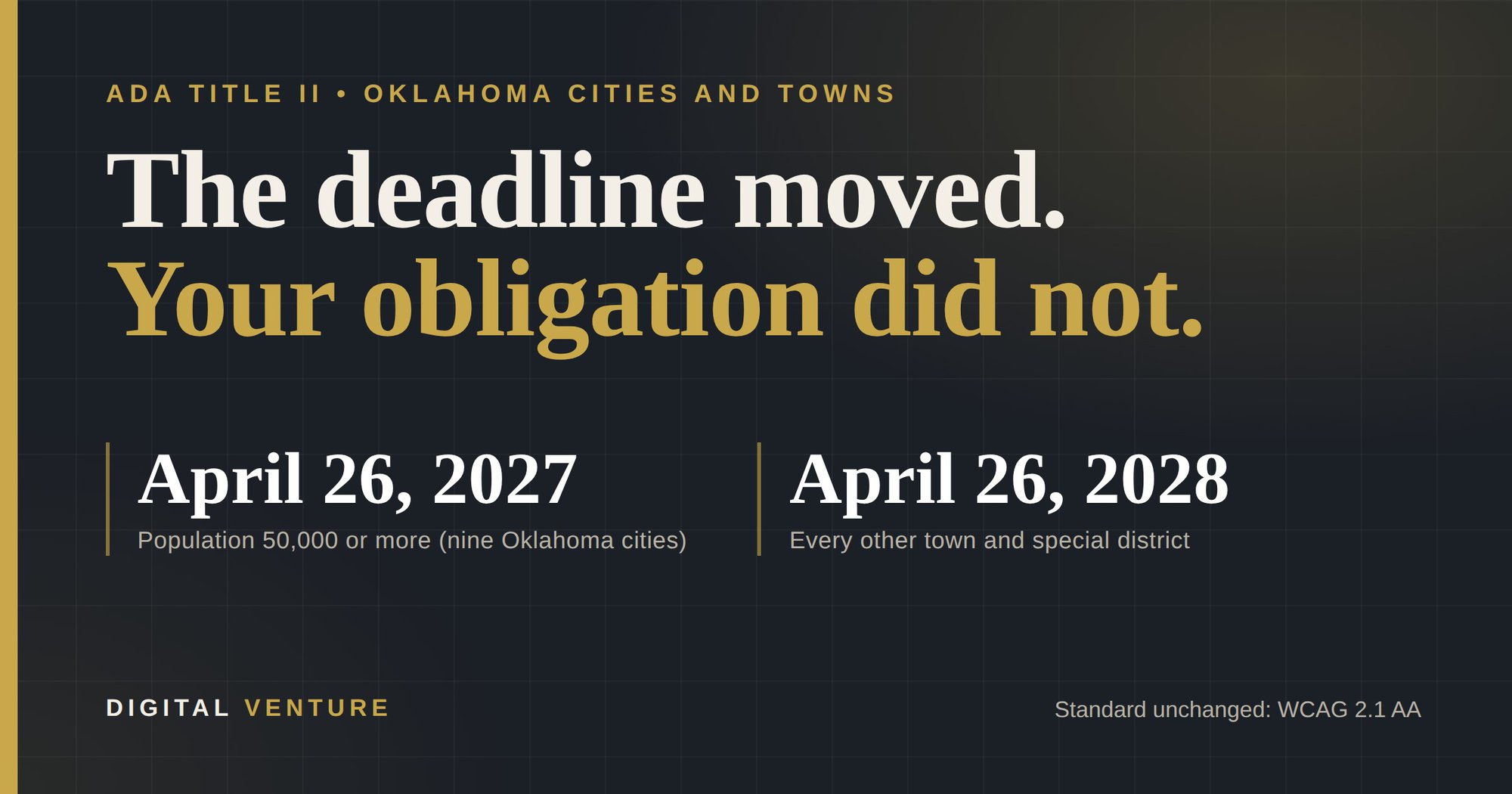
The ADA website deadline moved to 2027. Here is what did not change for Oklahoma cities and towns.
Oklahoma cities and towns got more time on the ADA Title II website deadline, but not a pass. Here’s what changed, what didn’t, and what local governments should do next.
Read Article →Let's Build Something Together
Veteran-owned, Tulsa-based, and trusted by 375+ clients. Tell us about your next project.
Get In Touch →